Thursday, May 26, 2016

Woke Feminist Men: Engaging Black Men and Boys on Sexual Violence Activism


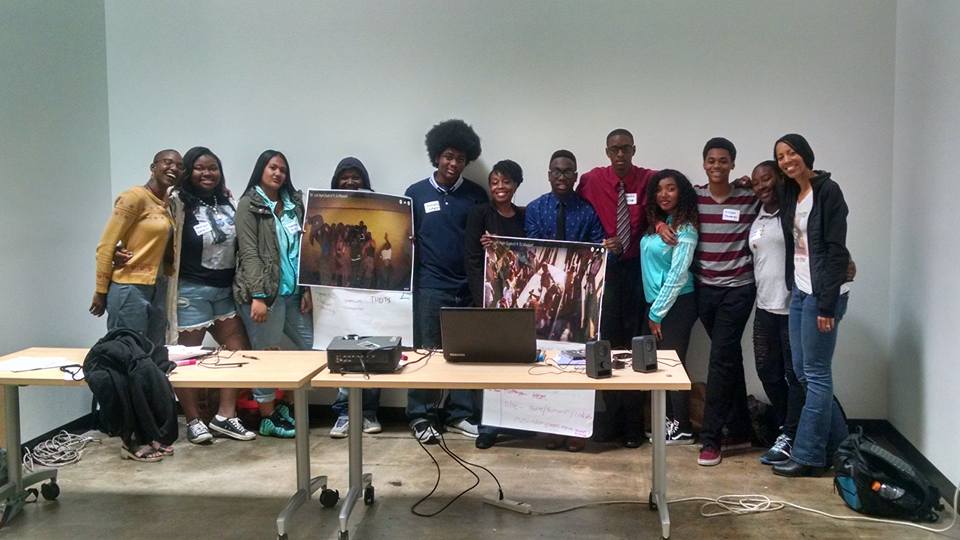
WLP MDR session boys presenting 2015
By Sikivu Hutchinson

In American classrooms, where black children are never granted the luxury of being thinkers, brainy dreamers and nerdy eccentrics, invulnerability becomes their default mode and safe space; protective armor from the criminalizing gaze of school police, administrators and teachers.  Inundated with racist pop culture images of violent black masculinity and hyper-sexualized black femininity, black boys in particular often struggle to define manhood in ways that aren’t based on hardness and controlling black girls and women. Black male feminist allies like Kevin Powell, Byron Hurt and Mark Anthony Neal have long championed linking anti-violence work on sexual assault, intimate partner violence and misogynoir with civil rights and social justice activism.  Powell calls for a progressive men’s movement to deprogram men and boys.  Yet, making sexual violence relevant to young men of color is hampered by legacies of anti-feminist “gender warfare”, epitomized by scorched earth attacks against forerunning womanist/feminists like Alice Walker, Michele Wallace and bell hooks. As a result, it is a persistent challenge to connect young black men to this work in their schools, communities and everyday lives.

How, then, do black feminist educators work with boys of color to redefine masculinity and engage a new generation of “woke” feminist young men?

When students in my all-black Young Male Scholars’ (YMS) high school program are asked to identify mainstream media examples of men of color being vulnerable, or expressing emotion that isn’t violent, objectifying and/or “turnt up”; most are at a loss.  Throughout the course of the school year, YMS students collaborate with Women’s Leadership Project students on sexual violence prevention peer education—co-coordinated with youth activists Issachar Curbeon and Brandon Bell from health justice organizations Black Women for Wellness and Wisdom from the Field— that unpacks sexist hetero-norms and attitudes about gender roles, gender identity and male bonding around violence. Critiquing the way rape culture influences public policy and media is key as many black youth don’t see themselves meaningfully represented outside of violent dehumanizing imagery. In addition, black boys are programmed to view racist victimization as the primary issue confronting black communities, unaware of their own privilege and the ways black women and girls are subject to systematized sexual, domestic and intimate partner violence.
YMS WLP rise up
WLP and YMS youth educators, 2016
The influence of this erasure runs deep.  According to a 2005 Justice Department study, “black victims reported sexual assault at much lower rates than white victims, [and] while 44 percent of white victims report sexual assault, only 17 percent of black victims did”. Black women and girls continue to be the most vulnerable and most targeted populations when it comes to sexual violence and sex trafficking.  Moreover, public agency interventions that address the sex trafficking of minors are often not culturally responsive. Time and again white folk who believe they are on the “frontlines” of "rescuing" trafficking victims are ignorant of the context of black girls navigating poverty, misogynoir, sexual abuse and school push-out.  Sexual violence victimization is a key factor affecting the mental health and wellness of black girls K-12 schools.  And for youth of all genders and sexualities, prevention resources and education are virtually nonexistent.  Compounding matters, black girl survivors are often explicitly or implicitly told to just get over it and soldier on. In ultra-religious black communities they may be encouraged to seek therapy through patriarchal hetero-normative faith based institutions that view women’s sexuality as “the problem” and not American as apple pie rape culture.

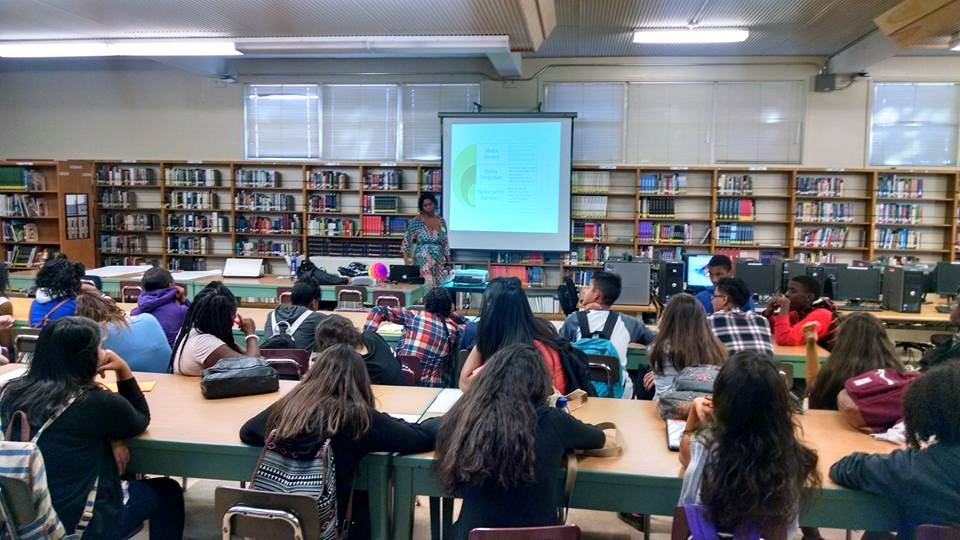
The Los Angeles-based Media Done Responsibly (MDR) organization has been a leader in educating youth to push back against the prevalence of sexist media violence. The organization promotes media literacy and advocacy by training youth of color to become aware about and challenge toxic media images/lyrics that they consume. MDR founder Shaunelle Curry works in schools and universities across Los Angeles County using a culturally responsive arts curriculum. MDR engages youth in media advocacy which targets the multinational corporations that promote and profit from sexist, misogynist images of women of color.  In addition, the organization trains young men of color to be facilitators at its partner schools and to commit to
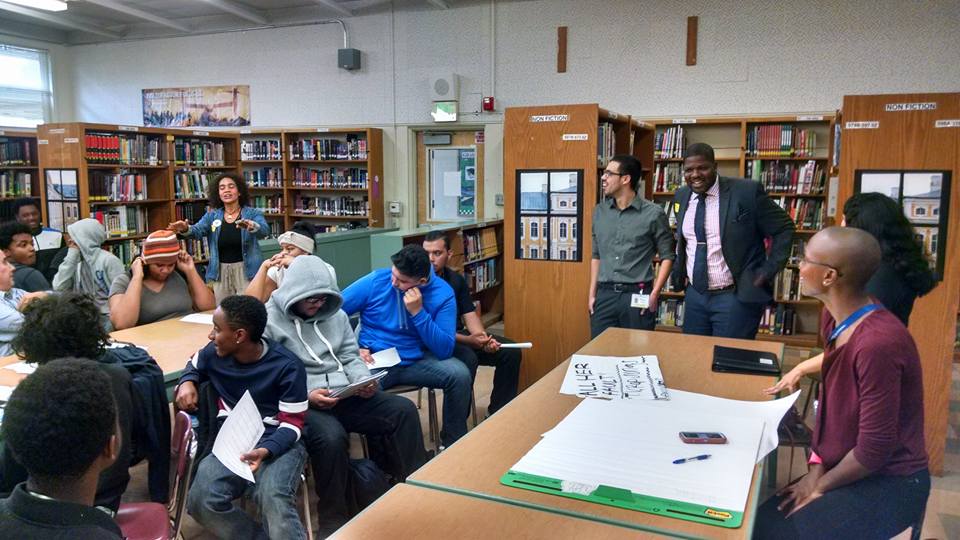
Sexual Assault forum: MDR, WLP, Black Women for Wellness
Sexual Assault forum: MDR, WLP, Black Women for Wellness, 2016
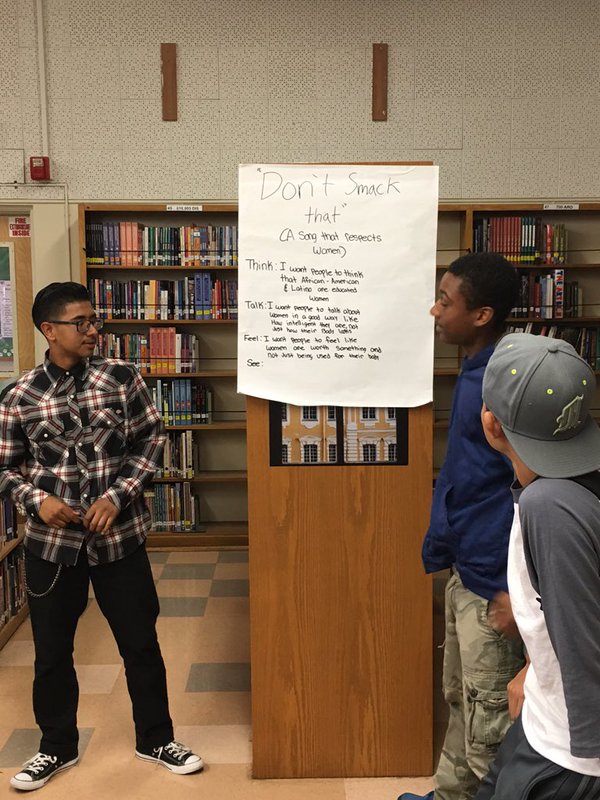
challenging rape culture and the normalization of sexual assault and sexual harassment. For example, working with young men, Curry and MDR do “a ‘Woman of Honor’ lesson plan in which students have to name a woman who’s been influential in their life that they love." According to Curry,  "We then hand out objectifying, misogynistic lyrics. We have them read them out loud and insert the name of the woman they honor and hear their name in this misogynistic language.  Some can’t do it.  This gives us a place to start the discussion.  Many of them just listen to the beat not the lyrics.  We also look
WLP MDR, 2015
WLP/MDR Media Advocacy, 2015
at why this is the predominant way black and Latino women are represented in media culture.  In this respect, they begin to deconstruct how women are just there for male pleasure and desire; while understanding how this impacts the cycle of violence, abuse and degradation of women.”

Recognizing young men and boys as violence victims/survivors is also a crucial piece.  Gender violence prevention educator Clifton Trotter, formerly of the anti-violence prevention organization Peace Over Violence, has worked directly with young black men on its Engaging Men project (in partnership with the L.A.-based Brotherhood Crusade).  He spoke recently with YMS and Women's Leadership Project students about the initiative, which leads young men through a ten-week violence prevention education program that focuses on hypermasculinity, violence in dating relationships, sexual violence and black fatherhood.  After the training, youth participants develop confessionals, reflections, personal narratives and poetry into a dynamic performance piece that can be used in classrooms and community outreach.
Engaging Men, Peace Over Violence 2016
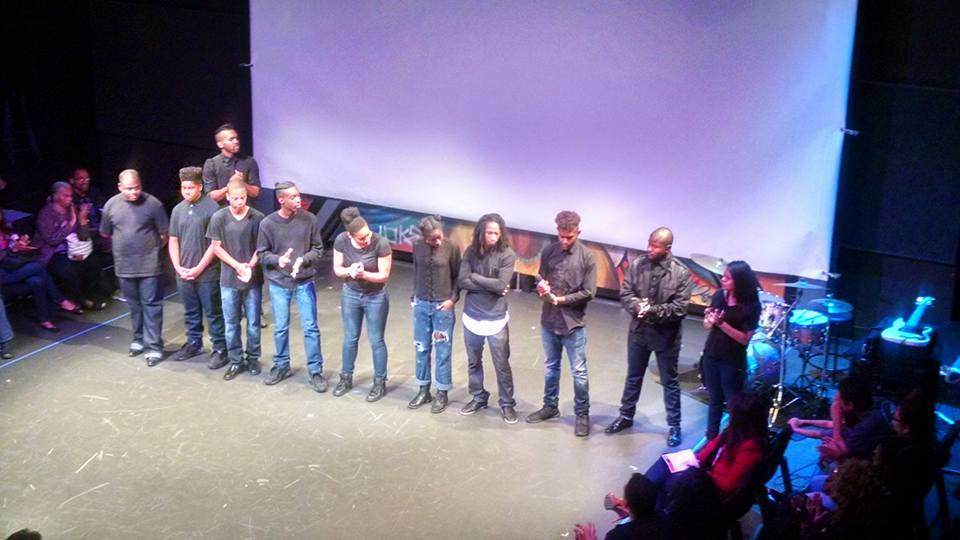
Trotter notes that male entitlement is one of the biggest challenges to developing young men as allies when it comes to addressing the normalization of violence against women. He says, “This is especially true for young men and boys who haven’t been exposed to this paradigm shift because there is already a defensive posture. It’s important to convey to our young men that it’s not an indictment and [that this issue] is bigger than you.”
Recently Kandee Lewis, executive director of the Positive Results Corporation, which focuses on teen violence prevention, organized a multi-generational male conference in Los Angeles that explored male trauma and healing. Lewis maintains that “Most young men are confused because of the images they are exposed to and the trauma from the
PRC conference on Redefining Manhood, Love and Violence Prevention
PRC conference on Redefining Manhood, Love and Violence Prevention, 2016
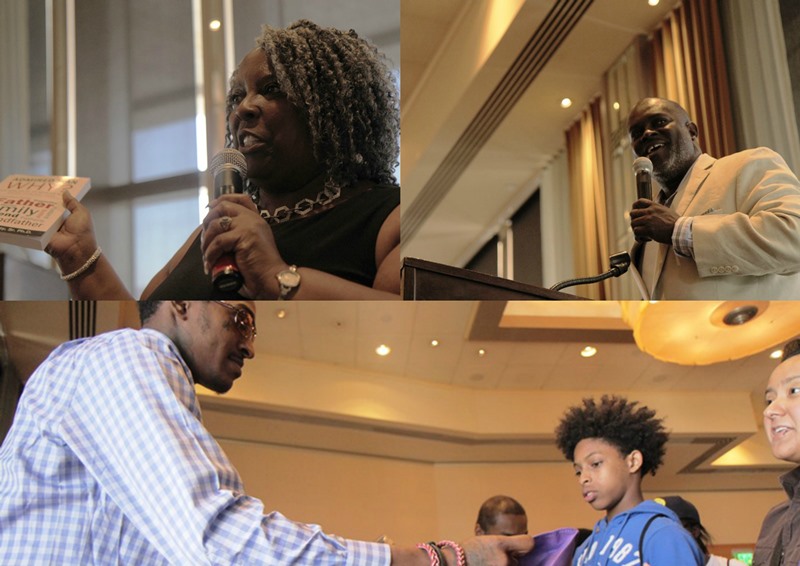
violence they may have seen or experienced at home.  In relationships too often young men feel they have to prove how much of a man they are, and that includes the way they speak to women and behave around women.” All of the male conference presenters spoke from their experiences with domestic and sexual violence.  Far too often, homophobic and transphobic norms dovetail with racist stereotypes to shame, marginalize and victim-blame black male sexual violence survivors into silence. Reflecting on the impact of the conference, two young men who attended said, “Young men need to know that it’s ok to be different, to subscribe to non-violence…to not succumb to peer pressure, and to not feel obligated to” be complicit in behavior that dehumanizes girls and women.  In an age of mass black resistance, this continues to be one of the most radical propositions.
Media Done Responsibly will host a fundraiser and awards ceremony honoring artist-advocates for diversity on June 2nd.  Click for more information

Sikivu Hutchinson is founder of the Women's Leadership Project, a contributing editor for TFW and author of the novel White Nights, Black Paradise. twitter @sikivuhutch

Wednesday, April 27, 2016

Black Rage, Black Silence & Sexual Violence


By Sikivu Hutchinson

There’s a powerful sequence in black feminist lesbian filmmaker Aishah Shahidah Simmons’ 2006 documentary No! on sexual assault in the African American community, that intercuts between Black Muslim leader Louis Farrakhan and another male minister in the pulpit rallying a charged black audience against rape victim Desiree Washington.  In 1991, Washington was a Miss Black America contestant who accused boxer Mike Tyson of raping her in his hotel room.  Tyson served three years in prison for the rape.  In the film, both “men of god” dismiss Washington’s charges as frivolous and call on the Lord to protect Iron Mike.  “Ladies,” Farrakhan thunders, “You know full well the evil you do!”

The film’s image of black women as Jezebel temptresses exposed by righteous patriarchs seeking to redeem the name of a “good man” is a blistering and still timely example of the complicity of organized religion in black women’s sexual victimization.

As youth and adults across the nation observe Denim Day, the Peace Over Violence organization’s annual campaign for sexual assault awareness month, what often drops out of public discourse is how racist, sexist and hetero-normative gender norms demonize black women and girls as improper sexual assault victims.

When black female sexual assault victims make headlines it’s either because their abusers are “white” like Daniel Holtzclaw or wealthy and powerful like Bill Cosby.  The “ordinary” black female victim, and the abuser who lives in her house, sits next to her in the classroom, stalks her online, rents out her body or spews pious hypocritical shit about virtue from black church pulpits while preying on women after hours, are seldom seen, heard or acknowledged by our communities.   

Whereas each week brings a tide of white female victims/survivors accusing, and, sometimes, triumphing over their abusers, black women and girls remain invisible, both as victims, survivors and heroines fighting back against sexual assault.  According to noted psychologist Gail Wyatt, “African-American women are raped at a higher rate than white women, and are less likely to report it.”  Given the slave era legacy of institutionalized rape and sexual assault of black women, her assertion is not revelatory but still has the power to stop one cold.  Amidst the overriding narrative of black man-as- über-victim-of-racial terrorism and state violence, why would the stories, the pain, the rage of ordinary black women sexual assault survivors be believed?

This question was amplified for me during a discussion about the impact of the school-to-prison pipeline at a community organizing meeting I attended recently.  Brainstorming about solutions to criminalizing school environments, there was little consideration among the group of how the experiences of girls of color with sexual abuse lead to their push-out and incarceration.    The discussion illustrated how gaps in intersectional organizing can be disenabling.  For, even as it has become more acceptable to talk about state violence against black women and girls in school communities, it is still difficult to broaden the narrative to consider how this relates to sexual violence committed by men of color.

In its 2015 report on the sexual abuse to prison pipeline, the organization Human Rights for Girls criticizes the arrest and incarceration of girls of color for non-violent offenses that largely stem from “childhood sexual abuse, (in which) a child that is being abused is trying to protect herself.” Black girls are disproportionately arrested and incarcerated for non-violent offenses committed as a result of the trauma of persistent sexual abuse.  Prior to Los Angeles County’s introduction of a policy discouraging the arrest of minors for prostitution (which is in actuality sex trafficking), the majority of those arrested for child prostitution in the County were black girls. This move was partly inspired by the Human Rights for Girls’ “No Such Thing as a child prostitute” campaign, which seeks to decriminalize underage trafficking victims who, if they are girls of color—straight, queer and trans—are often prosecuted and jailed for prostitution rather than treated as sexual assault survivors.

When we talk about the sex trafficking and prostitution of black girls in my high school classes there is often harsh judgment.   “I don’t care if she’s a 'ho',” one girl says, “It’s her business what she does”.  Among this group of girls, some of whom are abuse survivors themselves, there is little sympathy for young victims of sexual assault.  Turning their own trauma inward into self-blame, some believe that black girls in particular “know what they’re doing”.  They are not fragile, indecisive and malleable like white girls, they say.  They are in control, in charge, savvy entrepreneurs in league with the much older men who rape and sell their bodies again and again.

The myth of the strong, indomitable black woman is still a barrier to black girls being able to see themselves as victims, be it of intimate partner violence or sexual assault.  And because the movement to eradicate sexual violence in communities of color—spearheaded by organizations like the Black Women’s Blueprint, Black Women for Wellness, the Black Women’s Health Imperative and Sister Song—often has so little visibility, black girls internalize the toxic narratives that white supremacy, black misogyny and organized religion have normalized.  It is a bitter lesson that Desiree Washington, and other black women survivors, struggling in communities that don’t recognize their trauma and rage as legitimate, know all too well.


Sunday, April 17, 2016

Whose Bodies? Black Lives Matter and the Reproductive Justice Imperative


By Sikivu Hutchinson

From The Humanist

Abortion as Black genocide.  The most dangerous place for a black child is the womb.  Over the past several years, these toxic canards, often cloaked in civil rights rhetoric, have been used to smear abortion and demonize black women’s bodies. In 2009, when conservative organizations began targeting communities of color with anti-abortion billboard propaganda, black and Latina women’s organizations fought back with their own billboards and media campaigns.  These unrelenting assaults on the reproductive rights and self-determination of black women are epitomized by the wave of anti-abortion and anti-contraception state laws that have rocked the nation. One of the most egregious recent examples is a Missouri bill dubbed the “All Lives Matter Act”, which would define a fertilized egg as a person with rights.  This blatant appropriation of the Black Lives Matter mantle is just another example of the right wing’s efforts to undermine black liberation struggle by distorting the language of human rights.

To bolster its claims that abortion is genocide, images of Planned Parenthood founder Margaret Sanger are stamped with Nazi swastikas. Historically revisionist assessments of Planned Parenthood conveniently omit the connection many early 20th  century progressive Black activists made between family planning, birth control, abortion, and black liberation.  Tellingly, prominent Nazis like Martin Luther King, Malcolm X, Mary McLeod Bethune and Ida B. Wells supported Sanger’s controversial work with the Birth Control Federation of America.

In February, in an effort to address this tactic, Black Lives Matter activists publicly aligned with reproductive justice activists.  Historically, reproductive justice has always been about more than just unrestricted access to abortion and birth control.  Under slavery and Jim Crow, black women had little to no control over their reproductive destinies. In addition to having the least wealth of any group in the U.S., black women are also more likely to get abortions—precisely because of wealth and health care disparities. Thus, for black women, reproductive justice is a precondition for mental health, wellness, bodily autonomy and community enfranchisement.  Spearheaded nationally by the Atlanta-based African American women’s organization Sister Song, the concept of reproductive justice draws upon the notion of intersectionality, which situates women’s right to self-determination within a broader economic justice and human rights framework.  As Sister Song notes:

Reproductive Justice is a positive approach that links sexuality, health, and human rights to social justice movements by placing abortion and reproductive health issues in the larger context of the well-being and health of women, families and communities because reproductive justice seamlessly integrates those individual and group human rights particularly important to marginalized communities. We believe that the ability of any woman to determine her own reproductive destiny is directly linked to the conditions in her community and these conditions are not just a matter of individual choice and access. 

Discussing the relationship between Black Lives Matter activism and reproductive justice, BLM co-founder Alicia Garza maintained:

I think from our perspective, reproductive justice is very much situated within the Black Lives Matter movement. And the way we that talk about that is that essentially, it’s not just about the right for women to be able to determine when and how and where they want to start families, but it is also very much about our right to be able to raise families, to be able to raise children to become adults…. And that is being hindered by state violence in many different forms. One form being violence by law enforcement or other state forces, and the other form of crisis through poverty and lack of access to resources and lack of access to health communities that are safe and sustainable. So we certainly understand that BLM and reproductive justice go hand in hand. 

This is an important juncture in the BLM movement because it further broadens its scope, making an explicit connection between anti-abortion legislation, reactionary misogynist, anti-black “messaging” and economic justice activism. BLM’s embrace also comes at critical moment in the national mobilization over women’s rights. As the Supreme Court weighs HB2, a Texas law requiring that doctors who perform abortions at local health clinics have hospital admitting privileges, the threat to health care for poor and working class women has deepened. If the court upholds this dangerous law Texas would be left with as few as nine abortion clinics and other states would have the right to enforce similar laws.  The insidious implications of this shift should be a catalyst for further intersectional organizing—bringing together humanist, feminist and progressive voices against the forces of religious and political fascism.      


Wednesday, March 30, 2016

10 Fierce Atheists: Unapologetically Black Women Beyond Belief


By Sikivu Hutchinson

There’s a pivotal scene in freethinker Lorraine Hansberry’s 1959 play A Raisin in the Sun in which matriarch Lena Younger tries to put the fear of God in her rebellious, politically conscious daughter Beneatha.  Beneatha, an Afrocentric atheist, has been mouthing off about God’s non-existence and irrelevance, proclaiming “Mama…it’s all a matter of ideas and God is just one idea I don’t accept…I get so tired of Him getting credit for all the things the human race achieves through its own stubborn effort.”  Lena responds by slapping Beneatha and making her repeat, “In my mother’s house there is still God.”

Lena’s violent rebuke of Beneatha is a caveat to all the uppity Black female atheists who’ve been rendered invisible—both by a white secular culture that only sees atheism through the Islamophobic lens of Richard Dawkins, and a black religious culture that uses heteronormative Christian respectability politics to silence and police women.  Decades after the literary slap heard around Black America, to be female, beyond belief and Black (to recast Hansberry’s iconic phrase) is still the ultimate betrayal of the race.  

Nonetheless, over the past several years, Black women have assumed leadership roles in the secular, humanist and atheist movements. But they continue to be eclipsed by white male gatekeepers whose narrow, often reactionary, view of secular practice and ideology has come to define organized atheism.   The challenge is compounded by the prevalence of Jesus-idolatry in mainstream African American culture (if you’re a rapper/singer/actor/politician who doesn’t publicly thank god/Father god/Jesus/Him for your success you practically get your race credentials revoked) as well as the relative dearth of scholarship on Black women’s secular practice.  How, then, do black women go beyond belief, while working within their communities as activists, educators and writers? And how do they connect their humanistic views and atheism to blackness, queerness, feminism, social justice and pushing back on white supremacy?  For Women’s History month here are ten fierce, unapologetically Black women atheists who are doing just that:

Deanna Adams is the author of the blog "Musings on a Limb," where she expresses her views as an African-American, atheist, professional mom on subjects related to the intersectionality of racism and skepticism.
“I believe the Black church has done great harm to Black women, especially with its misogynistic gender roles that demean us intellectually while using us as workhorses to further the aims of the church/pastor. My goal is to encourage other Black women to break the bondage of the psychological abuse known as religion so we can actively take on the dismantling of the white supremacist patriarchy, which remains because of our learned docility.”

Diane Burkholder is a Black mixed-race queer atheist shit starter, currently living in Kansas City, MO. She is a founder of One Struggle KC, co-moderator of Kansas City Freethinkers of Color and co-moderator of Kansas City Mixed Roots. 

“I describe myself as an ‘atheist’ to normalize the term among Black and Brown people as many are taught that atheists are white men who ‘worship the devil’.  As a Black feminist who lives in the Bible belt, I use my voice to create space for other non-religious people who are often shut out of social justice conversations because they are not ‘in the church’. It's also critical that we dig deeper and unpack our internalized oppression. We cannot replace white supremacy with Black heterosexism- they are all tools of power and control. ALL Black people must be free, not just ‘conscious’ heterosexual Black men. Intersectionality or bust.”


Bridgett “Bria” Crutchfield is an agnostic atheist, secular activist, secular leader, fabulously 40-something out lesbian. She heads the Black Non-Believers of Detroit group.
“I am a black woman, lesbian and atheist.  I fight for the underdog because no one fought for me.  My being an atheist is an integral part of my being and it'll be a cold day in hell before I sweep myself under the rug in order to assuage the masses.” 


Debbie Goddard is a queer, atheist, secular organizer, skeptical activist.  She is vice president of outreach and director of African Americans for Humanism at the Center for Inquiry.

“I see too many good people use religion to defend and shield their prejudice, bigotry, and inaction.  As a queer black atheist in America, I know that if things are going to change, then we need to question and challenge those religious attitudes.  And we need to take action now, today, in this world, instead of waiting for justice in some imagined afterlife.”


Laurie James, is an atheist “maverick” and accounting administrator

“I spent 30 years in the faith...after struggling with continuous doubt, I finally abandoned the faith. I thought god must be horribly incompetent, sadistical, or just doesn't exist. I concluded he doesn't exist.  For me, atheism means freedom; freedom to make my own decision, without the looming of a mythological god that can never be proven.”


Jimmie Luthuli is a public policy professional and a fighter for the rights of disenfranchised communities. She serves on the board of the Wanda Alston Foundation for LGBTQ homeless youth and is a member of Secular Sistahs of D.C.

“I identify as an atheist because supernatural creatures are not real.  More than that, the stories that surround their existence are all too often preposterous, frightening and oppressive.  Christianity was forced upon African captives who were kidnapped and enslaved in the Americas.”


Charone Nix has been a social justice /human rights activist for over 25 years. She is the co-host of the Lambda Radio Report on WRFG, Atlanta.
“As a disabled, queer, poor, feminist, atheist, it became clear to me that believing in a god was believing in invisible forces that work against my own interest.”


Liz Ross is a member of Black Skeptics Los Angeles and the founder of the Coalition of Vegan Activists of Color.

“I came to identify as an atheist after exploring the question of why there is so much senseless suffering – including animal suffering – and challenging white supremacy, patriarchy and anti-LGBT sentiment embedded in religious doctrine and our culture.  The experience also played a pivotal role in liberating my mind from negative reflections of myself.  Secular-humanist thinking helped me get a better sense of the interconnecting systems that create inequities in the world and reinforced in me the need to get involved in creating social change.”  


Mandisa Thomas is the founder and President of Black Nonbelievers, Inc.

“I am a Black atheist, and proud of it. Our existence is just as important to the Black community as any other, and there must be a reminder of the diversity that was always present. We can no longer treat atheism like the elephant in the room, even if we don't agree, there should be an understanding that we are here - and that we aren't going anywhere.”  


Ayana Williford is a 35 year-old social worker committed to social justice and empowering the black community.  She is a member of the Secular Sistahs.

“I identify as a Black female atheist by denouncing all forms of religious doctrine and advocating for other Black women to live freely.”

Sikivu Hutchinson is the founder of Black Skeptics Los Angeles and the author of Moral Combat: Black Atheists, Gender Politics, and the Values Wars. Her new novel White Nights, Black Paradise focuses on Black women, Peoples Temple and the 1978 Jonestown massacre.


Thursday, March 10, 2016

Just Give ‘Em a Little Jesus: Black Marriage Meets White Paternalism


By Sikivu Hutchinson


These days, a standard caveat from some religious black folk is that errant souls just “need Jesus” to straighten them out.  From white Christian missionaries to inner city street corner evangelists, “getting Jesus” and going to church have long been touted as the great antidotes to criminality and “bad behavior”. In their new book Soul Mates: Religion, Sex, Love and Marriage Among African Americans and Latinos, white Family Studies’ researchers Bradford Wilcox and Nicholas Wolfinger use this thesis to draw sweeping conclusions about churchgoing and recidivism rates among African American men, arguing that faith plays a key role in helping black men “flourish”. In a recent article in The Atlantic, entitled “How the Church Allows Black Men to Thrive”, the authors cite the higher levels of religiosity among African American men, claiming that “compared to their less religious peers, these 6 million or so black men are significantly more likely to thrive.” But it’s unclear who these “less religious peers” are (other black men? Non-black men?), because in the previous sentence Wilcox and Wolfinger note that non-black men are significantly less religious than black men.  However, although African Americans as a whole are overwhelmingly religious, black men have disproportionate rates of homicide, unemployment, incarceration and homelessness. In their data, the authors found that “only 4 percent of young black men aged 22 to 26 who attended church earlier in their 20s ended up in prison, compared to 6 percent who did not regularly attend church, again after controlling for a wide range of social and economic factors.” 

Yet, the 2% difference between those who did and did not recidivate is hardly a ringing endorsement of faith or churchgoing. And the suggestion that there is a causal relationship between faith and lower recidivism rates is simply not supported by the data.  One might ask— how is “faith” being defined? Is it “faith” in biblical literalism with its rigid gender roles and prohibitions on female sexuality and autonomy? And what social supports and employment options did the two groups of men have? What crimes were they convicted of? Presumably those who attended church were also beneficiaries of prisoner reentry programming and structured initiatives provided by church institutions, resources that were unavailable to those who did not attend church. If this is the case, then “faith” did not curtail recidivism—job training, educational counseling, mentoring etc. were, in all probability, more responsible.

The authors appear to confuse “faith” with social welfare provision, an institutional benefit that does not require religion or Christian morality. Because of the intersection of racial segregation, wealth inequality and capitalism, black churches are often the most prominent providers of social welfare in working class and middle class African American communities. Given these disparities, some churches may in fact provide a path out of recidivism because they are literally the only accessible avenue for cultural and communal connection in neighborhoods devastated by economic depression. But to suggest that recidivism is the most salient measure of black male “flourishing” ignores the insidious harm caused by cultures of sexual abuse, homophobia and transphobia which male-dominated churches often prop up and enable.

Further, recent studies have reinforced the secular thesis that religiosity does not determine moral behavior. Indeed, a study published last year in Current Biology concluded that Christian and Muslim children were actually less moral than non-religious children due to a phenomenon dubbed “moral licensing”. Moral licensing entails “doing something that enhances one’s positive self-image and makes them less worried about the consequences of immoral behavior.”
Another claim the authors make is that “regular religious practice helps make black men more marriageable—a term social scientists use to explain why some men are more likely to get married than others.” Churchgoing, we’re led to believe, transforms offenders into upstanding, law-abiding citizens.  In this missionary scenario, the sinners get Jesus—some even converting to Christianity in prison—and foreswear a life of crime (as one of their interview subjects noted, God “met me when I was selling drugs in prison. So, you know, that was a big thing for me, knowing that I have a relationship with God.”).

The authors’ conclusion that churchgoing makes (presumably heterosexual) black men more marriageable is laughable—it would certainly do so if only because of the high numbers of single black women who go to church seeking eligible bachelors (Deborrah Cooper chronicles the downside of this phenomenon in her scathing critique The Black Church: Where Women Pray and Men Prey).  The moral argument that church converts “disreputable” black men into respectable, marriageable patriarchs assumes that being in a straight marriage is the most desirable endgame and outcome for black men.  According to this logic, black churches mold “successful” black men because they impart certain moral and ethical values. But, again, the cold reality is that while African Americans remain the most solidly churched group in the U.S., our communities are plagued with some of the highest national rates of intimate partner violence, sexual abuse, sex trafficking (the majority of domestic minor sex trafficking victims in the U.S. are black girls) and HIV/AIDS contraction. Not only has the Black Church failed to adequately address these issues but it has often sanctioned the sexism, misogyny and homophobia which drive these ills.  Thus, the authors’ endorsement of hetero-normative respectability is both an offensive caricature of social conservative bootstraps arguments and an insult to black LGBTQ folk who have been victimized by homophobic and transphobic religious discrimination. Simplistic cause-and-effect valorizations of “faith” without critical analysis of how organized religion can be complicit in structures of oppression that hinder black America are insidious. 

Sikivu Hutchinson is the author of  Moral Combat: Black Atheists, Gender Politics, and the Values Wars and  White Nights, Black Paradise , a novel on Peoples Temple & the Jonestown Massacre


Wednesday, February 24, 2016

Bernie and the White Savior Shuffle


By Sikivu Hutchinson

Walk on water? Perform the miracle of five loaves and two fish?

To hear rhapsodic left-progressive Sanders’ acolytes tell it, these are just two of his many gifts as a beacon of social justice. It wasn't always so.  Over the past two years, Sanders has been challenged by Black Lives Matter and Black Alliance for Just Immigration activists, as well as African American commentators, about his mantra that remedying economic inequality is the only antidote to racial inequity.  Flash forward to the 2016 presidential campaign and the #FeeltheBern magic has captivated many African American and people of color progressives critical of Hillary Clinton’s neoliberal complicity in building the carceral state. Forced into a swift baptism, Sanders has become a regular civil rights evangelist, condemning the evils of racial discrimination and mass incarceration during high profile campaign appearances that have made him the darling of celebrity black intellectuals like Ta-Nehisi Coates and Cornell West as well as filmmaker Spike Lee.

Yet, Sanders’ dubious record on racial justice in his own state appears not to have presented a meaningful hurdle for his most fervent black supporters.  Although African Americans are 1.2% of Vermont’s population, their small numbers only partly explain Sanders’ well-documented disdain of intersectional analyses of race, poverty and economic inequality. 

A recent article in the Daily Beast outlined his rocky relationship with leaders in Vermont’s African American community. “Feeling the Bern” in another way, black leaders in Vermont have long criticized Sanders’ paternalism on race and racism. In a 2014 NPR interview about his presidential aspirations, Sanders was asked about racial disparities in job access and income.  He dismissed the question, implying that it was short-sighted if not petty; briskly pivoting to the more pressing issue of the Democrats’ failure to court white working class voters.   According to Curtiss Reed, head of the Vermont Partnership for Fairness and Diversity, Sanders constantly deflected on providing solutions to institutional racism with platitudes about addressing income inequality “overall”.  As one African American leader from Vermont contended, “voters of color are simply not on his radar” and are treated with “disdain”. One activist dubbed Sanders as MIA on issues of racial profiling, black mass incarceration and maintaining the state’s charter to the U.S. Commission on Civil Rights. So while Sanders’ newfound fiery rhetoric on the New Jim Crow has elicited black adoration, according to The Sentencing Project, African Americans “are sentenced to prison in Vermont at 12-and-a-half times the rate for whites. The percentage of blacks in Vermont prisons is nearly twenty times greater than the percentage in the general population.” Blacks account for over 10% of the state’s prison population and are incarcerated at greater rates than in lockdown champions Wisconsin, Texas and Louisiana.  In addition to its appalling incarceration numbers, Vermont’s African American students are disproportionately suspended and expelled.

Sanders’ reductive stance is a familiar one in the racially polarized history of left-radical alliances. In the early twentieth century, African American involvement in interracial communist-socialist organizing and coalition-building was undermined both by overt white racism and the white socialist thesis that capitalism alone posed the gravest threat to disenfranchised people of color (see for example Earl O. Hutchinson’s Blacks and Reds, Robin Kelley’s Hammer and Hoe and Jeffrey Perry’s Hubert Harrison: The Voice of Harlem Radicalism).  White segregationists, often driven by white immigrant animus toward black workers, played a key role in early twentieth century socialist organizing. Socialist icon and four-time presidential candidate Eugene Debs once commented that we “have nothing special to offer the Negro, and we cannot make separate appeals to all the races.”  This stance elicited scorching criticism from prominent socialist-aligned African American leaders like radical black freethinkers Hubert Harrison and A. Philip Randolph.

Until his Road to Damascus awakening, Sanders, like Clinton, said nary a word about the role white supremacy plays in black folks’ struggle for jobs, housing, equitable education and redress of the pervasive institutional violence against black women. Nonetheless, on the other end of the spectrum, African American leaders in the Congressional Black Caucus (CBC) rallied around Clinton and openly disdained Sanders’ oft-trotted out reference to his civil rights involvement back in the 60s.  This was no surprise given the CBC’s lockstep march with the Clinton regime and the Obama administration.  In a recent column in The Nation, New Jim Crow author Michelle Alexander argued that Clinton was “not deserving” of black votes yet dismissed the prospect of a viable Bernie-led revolution within the confines of the Wall Street-aligned Democratic Party.

As Alexander contends, “Even if Bernie’s racial-justice views evolve, I hold little hope that a political revolution will occur within the Democratic Party without a sustained outside movement forcing truly transformational change. I am inclined to believe that it would be easier to build a new party than to save the Democratic Party from itself.”  And if Sanders’ tenure with black folk in Vermont is any indication, he’s hewing to the Democratic Party playbook—ignore black voters until you have to go south of the Mason-Dixon or Black History Month rolls around, then “freedom fight”, and photo op, like hell.


Tuesday, February 9, 2016

Who Speaks for Black Girls on CSEC?

By Sikivu Hutchinson*
 
On Tuesday, February 9th, the LAUSD will vote on a resolution to address commercial sexual exploitation of children (CSEC) in Los Angeles school-communities. 
 
Although this resolution makes a general reference to the disproportionate number of African American children affected by the nexus of criminalization and sexual abuse; the resolution is lacking in its failure to identify culturally responsive prevention and intervention initiatives that would specifically address the disproportionate rates of victimization of black girls.  As founder of the Women’s Leadership Project feminist advocacy and mentoring program in South Los Angeles I work daily with young black girls who silently cope with the trauma and PTSD of sexual and physical violence in their school communities.  Inundated with cultural messages that demean and marginalize black girls and women, many of my students have grown up with the pervasive message that violence against black women and girls is normal, natural, and justifiable.  According to the Department of Justice nearly 40% of young black women have experienced sexual assault by the age of 18.  In L.A. County, black girls have the highest rates of domestic sex trafficking victimization and are more likely to be arrested and jailed for prostitution than non-black women and girls. Black girls accounted for 92% of individuals arrested for prostitution in 2010.  Indeed, “the decision to arrest and detain girls in these cases has been shown often to be based in part on the perception of girls’ having violated conventional norms and stereotypes of feminine behavior, even when that behavior is caused by trauma”.
 
 
According to the 2015 Human Rights for Girls’ report, girls of color are at the epicenter of the “sexual abuse to prison pipeline”.[i] And exposure to “sexual abuse is one of the primary predictors of girls’ entry into the juvenile justice system.”[ii]  African American girls in particular are more likely than their non-black peers to be re-victimized by sexual abuse in and trafficking through the foster care system. In the District, these trends are exacerbated by high push-out, policing and criminalization rates driven in part by low academic expectations, scant college preparation resources, high student-to-counselor ratios and limited health education curricula. These dynamics are especially acute in the South L.A. high schools I work with.  And while there is the perception that only black boys are heavily impacted by high rates of suspension and expulsion, black girls are also victimized by racially disproportionate discipline.

Targeted culturally responsive training, outreach and youth leadership development that addresses not just the victims and survivors of CSEC—but the educational, health and socioeconomic factors that allow sex trafficking to thrive—are urgently needed.  In order for these measures to truly impact CSEC youth the District must make an investment in partnering with community resource providers and advocates who are already working with vulnerable youth in the LGBTQ and gender non-conforming, juvenile offender, undocumented, homeless/foster and disabled communities.  These initiatives must encompass targeting social media; identifying cultures of abuse, predation and recruitment that exist on popular youth social media sites; incorporating boys into CSEC prevention and intervention education; as well as reinforcing mentoring programs, restorative and social justice leadership initiatives that provide healthy alternatives for youth in heavily impacted school-communities in South Los Angeles. 
Finally, it’s important to recognize that sex trafficking does not arise in a vacuum. It’s not only intimately connected with poverty in our communities and the normalization of sexual violence against women and girls, but with the perception—deeply ingrained in a District where black boys and girls are disproportionately suspended and shut out of college access—that certain youth are disposable. The District has an obligation to do more than draft feel good platitudes but to push for equity with real teeth and sustainability.


*Remarks to LAUSD school board


[i] Human Rights for Girls, “The Sexual Abuse to Prison Pipeline: The Girls’ Story,” Georgetown University Center for Poverty and Inequality, 2015, pp. 7-15
[ii] Ibid.