Tuesday, June 29, 2010

Pink Princesses, Blue Commandos


By Sikivu Hutchinson

My daughter is no princess. Loud, assertive, and headstrong, she would just as soon as stomp on a castle drawbridge with her big size six feet than pine coyly from it, twirling a dainty lock of hair waiting for a Ken doll suitor. Yet the multi-billion dollar media marketing regime is poised to shoehorn her 2 year-old self into being one. As any parent with eyes and a pulse knows, a trip to Americana’s favorite non-unionized big box retailers is a crash course in the enduring power of gender segregation. Trundling through the “girls’” toys aisle, maneuvering the explosion of pink frilliness, one expects to bump into June Cleaver or Donna Reed. Baby dolls, play ovens, play houses, strollers, dress-up kits, make-up and the ubiquitous princess accessories, addle the senses. Around the corner in the boys’ commando-in-training section, trucks, balls, science kits, building sets, Legos, blocks, action figures, guns and other rough n’ tuff paraphernalia signal a return to the jungle of discovery, adventure, violence and enterprise.

In the ostensibly secular democratic West, this surfeit of consumer options represents “choice,” rather than cultural indoctrination. Parents can just vote with their pocketbooks and not buy these products. Unlike in the fundamentalist monolithically gender repressive Middle East little American girls certainly aren’t programmed to be subservient. Women in power broker positions abound and capitalist consumption is politically "neutral."

Indeed, proponents of shattered glass ceilings point to recent job data that suggest American women are actually making bigger employment gains than are men. The decline of the construction and manufacturing industries has severely limited men’s job opportunities. Coupled with the higher proportion of women in four year colleges, American women would seem to be making out like gangbusters.

There are serious flaws in this premise. First, the gender wage gap shows no signs of narrowing. According to the Center for American Progress, women are the primary breadwinners in over 1/3rd of American families. Women are still relegated to the lowest paying service industry jobs in child care, clerical work, domestic work, and teaching. And black women, who are more likely to be single working parents than are women of other ethnicities, remain at the bottom of the gender wage ladder. Secondly, and most egregiously, the new job data fail to account for the double and triple burden of women’s work. Regardless of whether they are custodians or corporate execs, women continue to be saddled with the majority of child care, housework and adult caregiving. The minute a working mother hits the door down time and breathing space are sacrificed for an array of cleaning, parenting, cooking and counseling duties. Sacrifice is a woman’s creed and to-die-for duty. And it is this message that the big box retailers’ flotilla of pink baby dolls, strollers, play houses, et al. are designed to instill in little sacrificial princesses in training.

The ubiquity of this social programming inspired two British women to start the Pink Stinks campaign, which targets retailers who market gender segregating toys and accessories. Yet the flip side of pink stinks is the dominion of blue. When my students presented a workshop on gender stereotypes in retailing to a group of their peers, the sole male participant commented that he had been targeted for not conforming to the model of “hard” masculinity because he liked to do hair. For young men, any activity that is remotely associated with caring or nurturing is feminine and therefore “gay.” As feminist writer Derrick McMahon notes in his article “Boys and Baby Dolls:” “Boys who wish to play with baby dolls are seen as punks, sissies, and weak…parents are quick to tell little boys that they have no business playing with baby dolls.” While young girls who “crossover” and express interest in traditionally masculine pursuits like car maintenance or science are tolerated as tom boys going through a phase, boys are punished with the heterosexist stigma of being less “manly.”

The consequences of this are exemplified by the epidemic of black male homicide. Trained to be hard, swaggering, aggressive and indifferent to the value of each others’ lives as mere “niggas,” young black males are inured to the violence they inflict upon each other. What would it mean then for the future of African American communities if there were a paradigm shift, and boys were raised to be caring and nurturing? Biological determinists argue that boys gravitate to cars and guns because they are genetically hard wired to do so. In her groundbreaking book Pink Brain, Blue Brain, neuroscientist Lise Eliot debunks this assumption through painstaking analysis of scientific studies on alleged innate sex differences. She argues that there is “little solid evidence of sex differences in children’s brains” and that adult perceptions of gender difference strongly influence children’s behavior.

As my daughter begins to navigate the minefield of gender norms and expectations she’ll be constantly told what is proper for a girl. She’ll be hounded by peers, adults, the media and organized religion to be sexually desirable to men on the one hand and chaste and virginal on the other. In a nation of liberated “post-feminist” women, she’ll be propagandized with the contradictory message that romancing kitchenware, cooing after baby dolls, and being a precious, sweet “daddy’s angel” are the keys to fulfillment. And as a third generation feminist she’ll be ably equipped with her loud mouth and big feet to storm the drawbridge of gender conformity.

Friday, June 11, 2010

Not Knocking on Heaven’s Door:* Black Atheists, Urban America


By Sikivu Hutchinson

Late Saturday afternoon, like clockwork, the street corner preachers on Crenshaw and King Boulevard in South Los Angeles take to the “stage.” Decked out in flowing robes and dreadlocks, they fulminate into their mikes about the universe, God’s will and “unnatural” homosexuals to a motley audience waiting for the next express bus. Members of the Black Israelites, they are part of a long tradition of performative religiosity in urban African American communities. This particular corner of black America is a hotbed of social commerce. Kids who’ve just gotten out of school mingle jubilantly as pedestrians flow past fast food places, mom and pop retailers, street vendors and Jehovah’s Witness’ hawking Watchtower magazines. The Israelites have become a fixture of this street corner’s otherwise shifting tableaux. Exclusively male and virulently sexist and homophobic, they are tolerated in some African American communities in part because of the lingering visceral and misguided appeal of Black nationalism.

While the Israelites’ millennialist “racial uplift” ethos ostensibly fits right in to the bustle of this prominent South L.A. street, other belief systems are not as easily assimilated. Since 2006, the L.A.-based street philosopher Jeffrey “P Funk” Mitchell has been documenting his conversations with everyday folk on questions of atheism and faith. Using the handle “Atheist Walking,” Mitchell also conducts free-ranging inquiries into Christianity’s contradictions with a rolling video camera and a satirically raised eyebrow. Adopting the role of the bemused urban flaneur, ala the commentator- pedestrian immortalized by French poet Charles Baudelaire, he delves into “atheist spirituality,” biblical literalism and the paradoxes of faith. Mitchell is a member of the L.A.-based Black Skeptics, a group that was formed earlier this year to provide an outlet and platform for secular humanist African Americans. The Skeptics are part of a small but growing segment of African Americans who are searching for humanist alternatives to organized religion. In May, the Washington DC Center for Inquiry’s first annual African Americans for Humanism conference drew over fifty participants. Chat groups and websites like the Black Atheists of America have sprung up to accommodate the longing for community amongst non-theist African Americans who feel marginalized in a sea of black hyper-religiosity. Organizations such as the Institute for Humanist Studies cultivate African American secularist scholarship and advocacy.

With over 85% of African Americans professing religious belief, black religiosity is a formidable influence. Racial segregation, the historical role of the Black Church, and African American social conformity reinforce Christianity’s powerful hold on black communities. Indeed, I was recently told that I’d been deemed an unsuitable culmination speaker for a bourgie philanthropic organization’s young women mentees because of my decidedly unladylike public atheism (Perhaps the Israelite’s Old Testament shout-out to silent prostrate women would be more acceptable). Proper role models for impressionable black youth are, at the very least, skillful church lady pretenders with ornate hats in tow. Secular organizations that seek to build humanist community with a predominantly African American base and social justice world view are challenged by the association of charitable giving, philanthropy, poverty work and education with faith-based communities. For many, successfully emulating the strong social and cultural networks that have sustained church congregations is an elusive goal.

And then, there is the deep and abiding desire for belief in the supernatural, the ineffable faith-passion that propels some through the trauma of racial indignities and personal crisis. Yet, humanism asks why we should cede enlightenment and the potential for restoration to the supernatural. Humanism challenges the implication that the sublimity of the natural world, and our connection to those that we love, admire and respect, is somehow impoverished without a divine creator. In one of his bus stop monologues, Mitchell comments, “I want people to look at each other with the same reverence that they look at God and realize that ‘we’ did this, we made this happen.” The “we” represents will, agency, and motive force; qualities that many believers would attribute to God as omniscient architect and overseer. Non-believers are compelled to ask whether individual actions (for good or ill) are determined by God, or whether human beings simply act on their own volition in a universe overseen by God. Since time immemorial, non-believers have questioned whether God exercises control over those who commit evil acts or whether hell is the only “medium” for justice. By refusing to invest supernatural forces with divine authority over human affairs, humanism emphasizes human responsibility for the outcome of our pursuits. Morality is defined by just deeds, fairness, equality and respect for difference; not by how blusteringly one claims to adhere to “Godly” principles.

However, in communities that are plagued with double digit unemployment and a sense of cultural devaluation, notions of self-sufficiency and ultimate human agency may be perceived as demoralizing if not dangerously radical. As a child preacher steeped in the fiery oratory of the Black Church, writer James Baldwin recounted his growing cynicism about spreading “the gospel.” Lamenting the grip of religion on poor blacks, Baldwin said, “When I faced a congregation, it began to take all the strength I had not to…tell them to throw away their Bibles and get off their knees and go home and organize.” In Baldwin’s view organized religion’s requirement that believers suspend disbelief and submit to “God’s will” is a liability for working class African Americans. Religious dogma anesthetizes as it bonds, a dangerous combination in an era in which the proliferation of storefront churches in urban black communities is a symptom of economic underdevelopment.

Echoing Baldwin, Chicago-based Education professor and atheist Kamau Rashid argues that “Freethought is an extension and expression of the struggle that African Americans have waged for self-determination. In fact it represents a heightened phase of such a struggle wherein one of the final stages of ‘conceptual incarceration,’ the belief in a God or gods, is discarded for a belief in the human potential, for a belief in ourselves.”

And why, in a heritage steeped in the revolutionary thought of such dirty outlaw skeptics as Frederick Douglass, W.E.B. DuBois, Baldwin, Zora Neale Hurston, Langston Hughes, Nella Larsen, A. Philip Randolph, James Forman and Alice Walker, would this be so viscerally frightening?

Sikivu Hutchinson is the editor of blackfemlens.org, a member of the Black Skeptics Group and the author of the forthcoming book Moral Combat: Black Atheists, Gender Politics and Secular America.

*With apologies to Bob Dylan

Wednesday, May 19, 2010

Expendable Lives, Distorted Images: The Murder of Aiyanna Jones


By Sikivu Hutchinson

When a little white girl goes missing, online news, supermarket tabloids and cable network stations bombard us with up-to-the-minute dispatches on the crime, the victim, her shattered family and anguished community. When a little black girl is murdered in cold blood by a big city police department it is up to the community and those who care about social justice to ensure that the case doesn’t fade into the national obscurity that is usually reserved for the lives of people of color. The recent execution of 7 year-old Aiyanna Jones by the Detroit Police Department during a raid while she was sleeping in her home is the kind of atrocity that makes many people of color view the police as an occupying army. According to news reports, the Detroit Police were conducting a raid that was being filmed for an A&E reality show. Searching for a suspect who lived in another apartment unit, officers fired into the home from outside, then lobbed a grenade into the house, killing little Aiyanna.

By exercising a so-called “no knock” policy in poor neighborhoods, the Detroit Police’s criminal disregard for human life and the civil liberties of people of color have kept the community under siege. According to Ron Scott of the Detroit Coalition Against Police Brutality, the Detroit Police have been under a federal consent decree but continue to use military style raids that terrorize citizens in its poorest neighborhoods.

Of course, deeply ingrained racist stereotypes and biases against people of color are a major factor in racial profiling and police misconduct. Disturbingly, Aiyanna’s murder also comes in the wake of a recent CNN study about the impact of skin color bias on young children. CNN presented the findings of Margaret Beale Spencer, a psychologist who utilized the same “doll test” technique as that of psychologists Kenneth and Mamie Clark in 1947. The Clarks’ research documented the destructive impact of racism on black children’s self-image and was used in the 1954 Brown vs. Board of Education suit.

Spencer asked black and white children to identify the child they believed had negative traits in a drawing featuring children of different skin colors. The majority of both black and white children found the darker skinned child to be the one which possessed negative traits, while they identified the lighter children as those possessing the most desirable traits. The association of whiteness with normalcy, power, attractiveness, worth and desirability is reinforced by mainstream media, the dominant culture, families, and children’s peers. So because there is often little in their home lives, school curricula or peer networks to counter this message, some children of color and most white children receive the constant message that whiteness is superior. White parents who claim that they are raising their children to be “colorblind,” and reflexively dismiss focus on racial or cultural difference as “promoting racism,” simply reinforce the dominant culture’s racist inscription of whiteness as the unspoken norm. Adults who ignore the very real and damaging overvaluation given to white or lighter skin in marketing and advertisements, as well as in film, video and TV shows with predominantly white casts (such as on the Disney Channel and the major networks), ensure that children will be ignorant of the power of white privilege.

Counter-programming children of color to believe that they are beautiful, capable, powerful and intelligent requires specific emphasis on the cultural richness of people of color. It requires school curricula that actively incorporate the contributions of people of color to every aspect of American social history, literature, science and mathematics. It requires that conscious white parents have conversations with their children about how race does confer social advantage onto whites and not people of color. And it requires that we continue to tear down the regime of white supremacy that fetishizes little white girls as the national ideal of innocence whilst disposing of little black girls as ghetto expendables.

Sikivu Hutchinson is the editor of blackfemlens.org. She is working on a book entitled Moral Combat: Black Atheists, Gender Politics and the Atheism Question.

Tuesday, May 4, 2010

Faux-reportage: Re-visiting Otherness, through the lenses of “the whitest people we know”


Photo: Kara Mears/The Entry Way
http://laist.com/2010/04/01/the_entryway_draws_criticism.php

By Diane Arellano

As post-race and post-colonial America intersect with the frontiers of multi-media reportage, white privilege re-emerges vis-à-vis “The Entry Way: Two reporters move into a new America.” The two reporters “courageous enough” (according to fawning reviewers and supporters) to move into “the new America” are photographer Kara Mears and writer Devine Browne. They are the self proclaimed “whitest people we know,” who have moved in to the home of a recent immigrant Mexican family to learn Spanish so they can better report on their city and country…and incidentally…develop a web based diary-style reportage project about living with Mexicans in MacArthur Park.

Although living with Mexicans in MacArthur Park may sound like a reality show, it is actually the real life venture of Browne and Mears that has attracted praise, attention, financial support, and criticism. Ironically enough, the birth of socially responsible documentary work came into existence as a backlash to common practices (similar to those implemented by Browne and Mears), which imposed western values and standards on Other cultures, often impeding meaningful cultural comprehension. Browne and Mears claim that they selected MacArthur Park and the home of Maria and Juan, “because we are more interested in what they think of our country than what we might think of theirs…” Nonetheless, the reporters haven’t been able to release themselves from perpetuating the narrative of the roach infested, can’t-speak-English and-refuse-to-learn-it, round-the-clock-TV-watching, impoverished Mexican immigrants:

“For two years I looked for the right family and knew I had found them when I took a tour of their house and saw a chore list on the refrigerator door and a list of rules on the bathroom wall.

No sean puercos! Don’t be pigs!

All over this neighborhood are cockroach infestations and kids who come to school with bed bugs crawling out of their backpacks and so the sign made me feel better; it said to me:

This family cares about cleanliness they cannot live with bugs.”

-Devin Browne on selecting a host family

Prolonged exposure to cockroaches and bed bugs has been proven to lead to health effects such as asthma, anemia and anaphylactic shock. Rat infestations can cause bacterial, intestinal illnesses, and parasitic disease, with greater risks to pregnant woman and children. This is a serious health issue that most severely impacts the health of poor communities (of all backgrounds) throughout the world. Browne however, manages to trivialize this fact by missing an opportunity to reflect on the potential impact on her health, because after all this is a personal narrative project (and not journalism, as she has adamantly stated). Perhaps, after thinking about herself long enough, Browne might have even began to consider and reflect on the health conditions this environment may have on the occupants of her temporary home, who have lived there before her arrival and don’t have an pre-planned exit date or access to housing in the suburbs like Browne does.

Browne and Mears use obsolete lenses to examine and interpret culture, race, class, and gender politics in MacArthur Park. Observations gleaned from Browne’s lens about the host family include, the habitual joblessness of Juan, Latina enjoy sexual harassment because they consider it “…Sunshine,” Latinos living with the reporters are too frugal to purchase communal toilet paper, and Latina mothers don’t want independent children. The observations lack a context in which class, gender politics, causes and effects are discussed. According to the reporters, MacArthur Park is a place full of deficits, “absent of anything white” such as “tampons, chocolate chips, and nuclear families.”

“Most white people with whom I talk about
Maria + Juan + Latino people in America

and it is sometimes that fast that we go from Juan + Maria to Latino people in America

Seem to agree

That if we lived in Mexico for a number of years
(Maria and Juan have been in the United States for three years, Maria and Hilario for eight years) and we did not learn Spanish, we would be very rude”

-Devin Browne

Often times, Browne uses her keen observations to create judgments as in the example above. Personally, I found this passive form of calling Maria, Juan, Maria, and Hilario rude for not having learned English, highly offensive. Browne is the offspring of a middle class family with a college education. If she did live in Mexico for a number of years, she would most likely leverage her socioeconomic background, ensuring that she would not have to derive her entire income from the underground cash based economies of Mexico. Maria, Juan, Maria, and Hilario were not raised cradled by middle class white privilege, and as a result have been relegated to the underground American cash economies. So then, why would Browne draw comparisons to people who lack her educational background and economic status? Another intersecting thought, is that being a monolingual Spanish does not grant a person the same privileges that being a monolingual or English speaker does. Not once have I met a bank teller, teacher, police officer or post office worker who could not speak English. It is beyond obvious that the Latino residents of The Entry Way who don’t speak English and are not legally able to work in this country are susceptible to being underpaid and exploited. They are at a socioeconomic disadvantage, and to passively suggest otherwise is an irresponsible and privileged outlook.

Recently Los Angeles Times journalist James Rainey wrote a piece defending the reporters and expressing his indignation over the treatment of “white women” writing and photographing about “life in a multi-family apartment in the barrio.” Other defenders of Browne and Mears have acknowledged The Entry Way could benefit from less navel gazing, however, this misstep in their eyes, can be attributed to the youthfulness of Browne (27) and Mears (24). Critics have also expressed that if the young reporters were not white, they would not have been criticized as severely or at all. This is a bizarre allegation given that even today the most notable examples of documentary work continues to be produced by white documentarians like James Nachtwhey, Susan Meiselas, and Mary Ellen Mark. However, the common thread in the seminal works of these documentarians seems to be a respect for humanity and a sense of responsibility towards those in front of the lens.

For example, in 1948 twenty year-old photographer Don Normark documented the low-income Latino/ predominately Mexican-American community of Chavez Ravine. The government eventually emptied Chavez Ravine, forcibly removing the last residents. In “Chavez Ravine, 1949: A Los Angeles Story,” Normark gives us images that are capable of telling an entire story in one frame. His portraits are of children reading to each other, workmen returning home, sisters combing each others’ hair, men at the liquor store, and a young girl prepared for confirmation. In other words, at tender age of twenty, Normark captured the stuff of peoples’ lives.

The respect Normark had for the community of Chavez Ravine is immediately apparent when one reads accounts of Normark’s impressions. It is obvious that it was a pleasure for him to photograph Chavez Ravine; perhaps it was this approach that allowed him to capture the variety of unguarded moments in this community. Yet, in The Entry Way, either by editing or photographic approaches, the written and visual narratives lack the curiosity or comfort level to portray any notions of individuality. Both Browne and Mears have acknowledged that fears about this community have prevented them from engaging certain people. Perhaps it is these fears that elicit cautious smiles or a notable distance in Mears’ photographs. It is hard to imagine what the work of Normark might have looked like if it had been riddled with fear and hesitation towards the residents of Chavez Ravine. While indeed, Browne and Mears have every right to be curious and investigate whatever subject matter they choose regardless of their racial or economic backgrounds, this is not the real issue. The real issue here is that Mears and Browne lack the cultural competence to execute a project that hearkens back to a time where non-whites were branded as uncivilized or exotic based on the values and standards of whiteness.

Browne and Mears’ irresponsibility is accentuated by a contemporary political climate where individuals can be stopped and questioned if suspected of being “illegal” in Arizona. It is a climate in which Iowa Republican congressional hopeful Pat Bertroche is running on a platform that includes micro-chipping “illegal immigrants.” Browne and Mears, however, would never be micro-chipped, even if they do live surrounded by people who would be the targets for this. No, Browne and Mears are simply reporters embedded in the frontlines, uploading “proof” of the inadequacies of “the new America” using the standards and measures of whiteness, constantly comparing how differently Browne, Mears, and their families do things.

I wrote this piece because I am a photo documentarian and an educator who is also in her mid-twenties. Age is certainly no excuse for developing projects that exoticize people who come from backgrounds that are unfamiliar, nor are they an excuse for economic and racial prejudice. The use of ethnographic methods that centered on “discovering people” and requiring non-western cultures to abide by the standards of the West are outdated. As a photo documentarian I do understand the difficulties of using one’s self as a filter for subject matters that we (documentarians) may not have formal education in. And I also empathize with the desire to provide a voice for a community that is largely under-represented in the media. However, it is precisely because Browne and Mears are working with vulnerable populations that “socially responsible” practices become all the more imperative. If “The Entry Way” is about creating a meaningful discourse, Browne and Mears must re-examine their thesis and be cautious about their tendencies toward exploitive narratives.

Diane Arellano is a photo documentarian and youth advocacy educator based in Los Angeles. Diane’s work examines sociocultural instability and flexibility, the intersections of marginalized communities, race, class, and gender roles. Her latest photographic body of work is “The Toronto Wranglers: Gay Country Line Dancers.”

Thursday, April 29, 2010

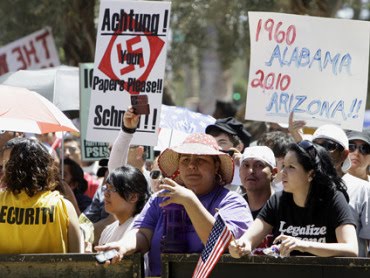
The Usual Suspects: Arizona and the Black/Latino Divide


By Sikivu Hutchinson

As soon as Arizona’s fascist anti-immigrant SB1070 legislation passed, black civil rights leaders from Jesse Jackson to California Assembly member Karen Bass roundly condemned it. The toxic national climate couldn't be more primed for this law. In recent months, the high octane atmosphere of jingoistic racism, xenophobia and Manifest Destiny posturing amongst white zealots and the legislators who shill for them has become standard order. Now that the nation is in an uproar over SB1070, civil rights coalitions have begun trying to mobilize African American opposition to the Bill by linking black social justice activism with the immigrant rights movement.

However when it comes to immigration rights and reform, there is a pronounced disconnect between black leadership and average black folk. In the L.A. African American Conservative Examiner respondents expressed support for SB1070. One believed that if similar laws were enacted in California it would be a deterrent to attacks on African Americans by Mexican immigrants. On the liberal to moderate The Grio website some black posters sounded off about bearing the brunt of racial discrimination, yet saw little connection between their experiences and an authoritarian crackdown on Arizonans of color under the legislation. Living elbow to elbow with Latinos in the same socioeconomically depressed communities, black anxiety over interracial violence and social/demographic usurpation by Latinos in the low wage job sector has intensified. In cities where black and Latino day laborers compete for construction and home improvement jobs, white hiring preferences for Latinos have ignited controversy over racist stereotypes about lazy blacks versus hardworking Mexicans. In Los Angeles communities where predominantly black neighborhood schools have become majority Latino, social and classroom segregation between the two groups is a hard reality. The prevalence of Latino anti-black prejudice, ranging from “pigmentocracy” bias to caricaturing blacks as backward and “ghetto,” is a recurring complaint among some African American youth. Further, the perception that Latino organizations don’t support African American activism around such issues as racial profiling and police brutality has long fueled mainstream black wariness of black/Latino coalition building.

It is little wonder then that during last month’s Washington D.C. immigration reform protests there was a notable dearth of black participation. According to the online magazine The Root, immigrants of African descent purportedly don’t participate in immigrant rights activism because of class differences with Latin American immigrants. African and Afro-Caribbean immigrants who come to the U.S. legally on H1-B or student visas may perceive immigration reform as a “Latino phenomenon.” Seeking professional careers, many don’t identify with the socioeconomic desperation that motivates undocumented Latin American workers and families to come to the U.S.

Homegrown black support for or ambivalence about the Arizona Law is symptomatic of a deep vein of frustration, anger, cultural resentment and xenophobia. Study after study indicates that African Americans are the most residentially segregated, suffer the greatest discrimination in job application and employment and are amongst the biggest recipients of predatory mortgage loans. Fifty six years after Brown v. Board there is greater social isolation between African Americans and whites in comparison to other racial groups. And white backlash to Obama’s election continues to illustrate the intractability of post-Jim Crow racism.

Because of the legacies of slavery and racial apartheid, the word “nigger” is still the universal signifier for dehumanization and otherness. For this reason, black liberation resistance has always been based on the struggle for recognition of both African American humanity and the basic right to citizenship. So there has always been a visceral yearning amongst black folk to wake up one morning and not be the ultimate other. A yearning to truly be considered a “native” son or daughter in a global empire based on forced African American immigration.

For many working class African Americans who see the gains of the civil rights era smoldering in the ashes of staggering unemployment, incarceration and high school drop-out rates, the plight of recently arrived undocumented immigrants does not register as a cause for solidarity. Ignorant of the bloody history of European imperial conquest of the Southwest, African Americans selectively lap up the white nationalist “taking back our country” swill at their peril. Creating a pure police state to "protect" (white) citizens from government coddled illegals and welfare leeches is part of the same old divide and conquer dynamic that allows the way white elites profit from illegal immigrant labor and low wage black labor to go unexamined.

Recently, a white Alabama Republican gubernatorial candidate called for the state’s driver license exam to be given in English because, "If you want to live here, (you need to) learn it." This nativist attempt to secure the borders of the new Confederacy is a harbinger of public policy that hearkens back to the literacy tests, poll taxes and other disfranchising regimes of Jim Crow. Word to ambivalent black folk—the narrative of nationhood, when spun by white supremacists, will never include you, no matter how Anglo your sur (read, slave) name or how “un-inflected” your English is. In the lynch mob mentality of some law enforcement, SB1070’s mandate for investigation with “reasonable suspicion” will always mean you.

Saturday, April 24, 2010

Debunking the Myth of a Colorblind France


By Sounia Johnson

In the early 1930’s many African American artists fled to Paris in order to escape racial inequalities and the constant oppression and dehumanization they experienced in the United States. “ Liberty, Fraternity and Equality,” a motto celebrating freedom that traces its roots in the French Revolution, attracted many African American expatriates such as James Baldwin and Josephine Baker, who found acceptance in what they perceived as a generous France -- liberal, receptive and a champion of social equality and civil rights.

Unexpectedly, a different reality was observed by world renowned American essayist James Baldwin. Baldwin witnessed the deep hatred toward and unequal treatment of French North Africans. Baldwin pledged his support of Algerians (referring to them as Paris’s niggers) while vehemently opposing the way the white French would treat minorities, thereby debunking the notion of colorblind liberal France.

It is thus not surprising that the widely held belief of a romanticized France does not hold any credibility for the many disenfranchised North Africans whose voices are consistently marginalized. The recent 2005 riots in France’s most underprivileged cities have been the result of ongoing racial and ethnic tensions. These tensions have highlighted the profound disconnect between the French Republic and overwhelmingly disenfranchised French Muslim youth, who are frustrated with being constantly marginalized as radical Muslim thugs, and not being given equal treatment as their white French counterparts.

Circumscribed access to education for the French-Magrehbi youth who mostly reside in insalubrious conditions housed in HLMs (Habitations De Loyer Modéré), commonly referred to as subsidized low-rent housing located in heavily Pan-African suburbs, is reflective of an unprecedented ghettoization not found anywhere else in Europe. These developments mirror housing projects found in American’s most underserved urban areas. The high unemployment rate— which in turns leads to juvenile delinquency amongst a frustrated urban youth— has led many young Muslims to fall prey to religious radicalism, with all the negative political implications this entails for France and the war against terrorism.

The problems are endless but are rooted in the fact that the French-Maghrebi youth cannot find sustainable employment due to lack of formal education and immeasurable social ills that have plagued and paralyzed young French North Africans into a dark abyss with no hope in sight.

Applying for a job with Arab-sounding names such as Mustafa, Mohammed, Nadia or Fatima remains a challenge for most French North Africans who feel that they are being discriminated against due to their dual French North African heritage. Because of this there is pressure to get French sounding names such Nadine instead of Nadia, Maurice instead of Mustafa. Many feel that their chances of finding employment are slim. Thus it becomes apparent that France’s emblematic motto of “Liberty, Fraternity and Equality” is an utopist venture which holds no credibility to those that find themselves being discriminated against by an alleged government that professes to be a champion of human rights and equality.

The lack of equal employment opportunities is a reality experienced amongst many French North Africans who feel that no matter how much they try, they will never be provided with the same opportunities accorded to their French white counterparts. This reality is reflected on the organization charts of many French Corporations, revealing a systematic white corporate ceiling culture. Racism is indeed well and alive in France.

With an increasingly diverse population, France must realize that it cannot keep burying its head in the sand nor turn its back on its youth. Race relations and inequalities have reached an unprecedented plateau, and ignoring rising tensions will create a further wedge between young French North Africans.

In order to regain its credibility as a champion of human rights, it is in France’s interest to aggressively incorporate equality laws that celebrate cultural and religious differences while investing in the crumbling educational system and rejuvenating urban planning in the inner cities. France must find a way to attract minorities to pursue fields that have historically been denied to them rather than inspiring kids to pursue vocational trades. France’s government must enforce stiff penalties against companies that practice discriminatory hiring practices in favor of an all white French work force.

What is needed in France is a highly educated work force that includes French Algerian lawyers, judges, doctors, politicians, journalists, corporate executives, scientists, but above all, an honest national discourse that celebrates cross -cultural differences while acknowledging France’s role in slavery and colonialism something France has yet to do.

Sounia Johnson is a French Algerian Los Angeles based correspondent for the North African Journal. Her perspectives on racism in France, as well as issues related to French-North African relations in Europe and French-Algerian life stand peerless. Follow this clever, adroit young writer.

Wednesday, April 21, 2010

The Bluest Eye Revisited


By Sikivu Hutchinson

She was an eleven year old African American girl ostracized by her small Midwestern World War II era community after she had been raped and impregnated by her father. Demeaned for her dark skin and “ugly” features, she became a repository for all of the community’s fears and anxieties about the status of black people in Jim Crow America. Perhaps no other book in contemporary American literature has captured the ontology of black female childhood experience and imagination as devastatingly as Toni Morrison’s 1970 novel The Bluest Eye. In the novel, Morrison’s preteen female protagonists bear fierce witness to the psychological disfigurements of racism, sexism, and segregation. They comment on the mystery of adulthood and the savagery of being dehumanized as young black girls in a culture that exalts the blue-eyed Barbie ideal. Speaking from an era in which racial progress was equated with the enfranchisement of black men, the female voices of The Bluest Eye quietly historicize the trials of black women in apartheid America.

Yet, thirty years later, Morrison’s portrayal is just as searingly relevant as it was when it was published at the height of the black power movement in the seventies. In its attention to the role media (as represented by 1940s Dick and Jane grade school primers and Hollywood film) play in shaping black adolescent female self-esteem, Morrison’s novel almost anticipates the intersection between the rise of 24/7 video and Internet media and the codification of racist/sexist imagery.

During a recent screening of a video on girls’ perspectives of media images in the high school class I work with, I was rudely reawakened to the resonance of The Bluest Eye, and the intensity of internalized racism and sexism among young black female students. Entitled What a Girl Wants, the video was a relatively tame portrayal of the effects of dominant images of sexuality in pop music videos and advertising upon middle school and high school age young women. Focusing on such overexposed mainstream artists as Britney Spears, Christina Aguilera and Mandy Moore, the video attempted to elicit candid reflections from girls on the connection between these media images and their own sense of self esteem, identity and future aspirations. In post video discussion the girls in my class responded intelligently about the media’s impact on normalizing casual sex for younger audiences. However, like modern day Pecolas, some of the young women bought into the belief that the booty shaking, thong wearing, weave sporting “vixens” of hip hop media are symbols of authentic black culture. Most disturbingly, when they commented on the sole African American girl who participated in the interviews, they raised a hue and a cry about her “unfitness” as an interview subject. The classes’ real objection was that the girl was not conventionally attractive; her dark skin and short hair making some of them refuse to identify with her as representing a genuine African American female viewpoint. The discussion then devolved into vigorous denials of their own black heritage. “I’m barely black,” one brown-skinned young girl declared, while another asked, “Why must we all be called African Americans even though we’re mixed with different races in us?” Far from being a relic of a bygone less enlightened era of black cultural identity, the skin color caste system among blacks remains rampant yet largely unaddressed by educators and youth advocates. These views are especially devastating for young women, who are disproportionately affected by the color regime in film, TV, video and print advertising, where depictions of black couples typically feature a black woman who is several shades lighter than her male counterpart.

Consequently, searching for media that deal with the authentic lived experiences of young women of color is a frustrating enterprise. Although there are a good crop of independent black female oriented websites (sistahs.org, blackwomenshealth.com) that open up new vistas for authentic expression, the Web continues to be catnip for an epidemic of adult voyeurism that has transformed childhood and adolescence into sexualized spectator sport. Young girls, sexualized at ever earlier ages, are constantly confronted by the funhouse mirror of normative femininity—the tighter and more revealing the clothes, the more provocative the sexual behavior and innuendo, the more desirable, and hence feminine, a girl is deemed to be.

This trend mirrors the way in which the sexuality of women of color has become a global fetish object. Global images of black femininity range from the suggestive symbols of black women with large Afros on hip hop t-shirts from Japan to such stereotypical depictions of the black woman as tacky prostitute trotted out in the 2006 film Borat. In this much-lauded “satire” of Americana, an overweight bleached blond black woman is parodied as the grotesque antithesis of normative desirable white femininity (represented by the silicone addicted Pamela Anderson). While the portrayal of this character, in a vehicle rife with scatological sexual references and over the top stunts, was framed as just another example of the movie’s irreverence, it gamely traffics in the recycling of the Jezebel/Mammy figure (perfected as of late by Queen Latifah) in contemporary mainstream media. A traveling journalist from Kazakh, Borat’s fleeting encounter with the prostitute is played for tragicomic relief as the antidote to his despair over the revelation of Pamela Anderson’s decidedly unchaste behavior in her pornographic wedding video. Later on in the film he commits the ultimate racial/social faux pas when he brings the woman to a society dinner at a Southern belle’s home and is swiftly ejected. He repairs to a local country and western dive where his lust interest climbs onto a mechanical bull and displays her “assets.” This interlude completes the Kazahk innocent’s voyage into the American heart of darkness, the travelogue of American blackness mapped through illicit sex, buffoonery and idleness. When Borat takes his paramour back to his native country as his wife at the end of the film, she fits in perfectly with the cultural pathology and primitive folkways of this Eastern European backwater.

It is not surprising that these images have gone unaddressed by many mainstream and so-called progressive critics, who’ve scrambled to out-drool one another hailing the film’s comic genius. Yet the ecstatic embrace of the film, and, by extension, its indictment of the black image (as a less than subtle caveat on cultural diversity and the vaunted freedoms of America), underscores how the media regime utilizes race and gender as powerful vehicles for repressive public policies. Increasing rates of STD and HIV/AIDS infection, the absence of culturally relevant sex education or the overemphasis on abstinence-only sex education, coupled with the cancerous global reach of misogynistic hip hop, have brought caricatures of black femininity back to the international fore as symptoms of American dysfunctionality. It is no wonder then that many middle and high school age black women struggle to achieve self worth and agency in their lives. The challenge for socially conscious educators and adults is to put the same emphasis on black female image formation as for black male image formation, and to help young women develop media literacy to fight back against the insidious assumptions that the global media regime imposes on their lives.